
Three benchmarks guide pixelprint's work: the ISO 9001 standard for quality, the ISO 14001 standard for the environment, and the Imprim'Pur charter, our written commitment to the environment. Click on a card to find out everything: what it is, who is behind it, and what difference it makes to your order.
 Imprim'PurOur environmental charterLearn more
An ISO standard does not certify a product: it certifies an organisation at a specific site. It is therefore useful to state clearly to whom each benchmark applies.
| Benchmark | What it covers | Who holds it |
|---|---|---|
| ISO 9001:2015 | Manufacturing organisation: inspection, traceability, handling of deviations | The production workshop, certified |
| ISO 9001 and ISO 14001 | Working method: quality and respect for the environment | The director of pixelprint, trained and certified to these two standards |
| Imprim'Pur Charter | Five environmental objectives | pixelprint, a trading name of SAS ATON |
ISO 9001 is the international standard for quality management, the most widely used in the world. It does not dictate what a banner or a panel should look like: it requires the company to write down how it works, to stick to it, to measure its results, and to correct anything that deviates. The current version dates from 2015.


Certification is not a self-declaration: it is issued by an independent body, after an on-site audit. The auditor reads the procedures, interviews operators, picks files at random, and checks that what is written is indeed what is done.
It must then be maintained over time: a surveillance audit takes place regularly, and the certificate is renewed. A company can lose it.
The workshop that produces your prints is ISO 9001:2015 certified. Your file is checked before printing, the order is tracked from one station to the next, and any deviation is recorded and addressed. The result is consistent from one order to another: the same colour, the same cut, the same finishes. The page Our workshops shows this process in detail.
ISO 14001 is the international standard for environmental management. It applies the logic of ISO 9001 to the environment: knowing what you do, measuring it, improving. It does not set a threshold to reach: it requires a verifiable continuous improvement approach. This is what distinguishes it from a mere statement of intent.
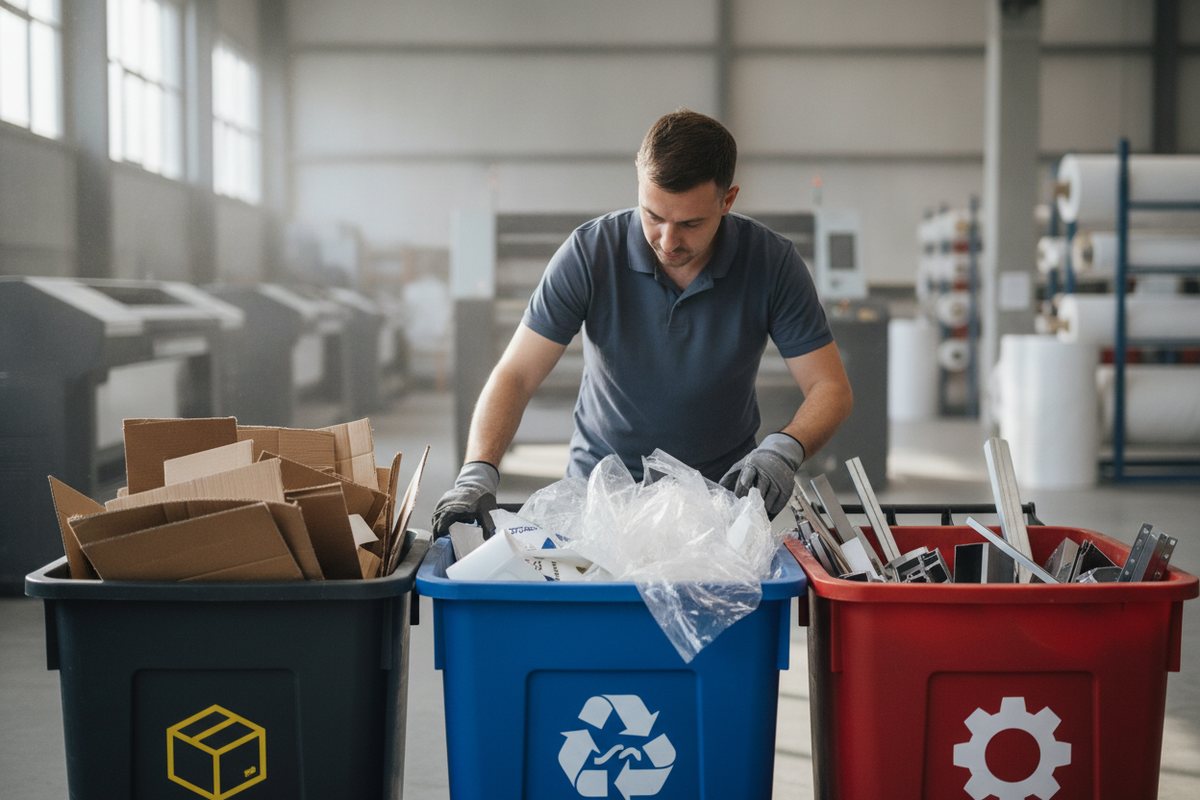

A cardboard offcut is not thrown away: it is sorted, compacted into bales, weighed, then handed over to a recycling stream. The weight is recorded. Year after year, these figures show whether progress is being made.
That is the whole difference between "we are careful" and a management system: here, things are measured, and someone checks.
The manager of pixelprint is trained and certified to ISO 9001 and ISO 14001 standards. These rules guide the tracking of every order, from file checking to delivery.
Imprim'Pur is our environmental label: a written charter in which we commit to continuously improving our environmental performance, in line with the national sustainable development strategy.

We hope in this way to contribute, at our own level, to leaving our children a cleaner planet.
The fifth objective of the charter concerns you: a print has less environmental impact when it is chosen wisely.
ISO 9001 focuses on quality: delivering what was ordered, reliably and consistently. ISO 14001 focuses on the environment: understanding and reducing the impact of one's activity. Both standards follow the same logic of continuous improvement.
The production workshop that manufactures your prints is ISO 9001:2015 certified. The director of pixelprint is himself trained and certified to ISO 9001 and ISO 14001 standards.
This is pixelprint's environmental charter: five written targets, from pollution prevention to raising awareness among clients and suppliers.
Not directly. It ensures that an organisation operates according to a documented, controlled and audited process. It is this process that delivers consistent results.
No. These are illustrative images showing the actions these standards involve: checking, tracking, sorting, compacting.