
FrançaisEnglish
pixelprint is a team in Nice that advises you, checks your files, and monitors your order, and a large-format production workshop, our main European production partner, that prints, cuts, finishes, and dispatches. This page shows how your order is made, step by step.
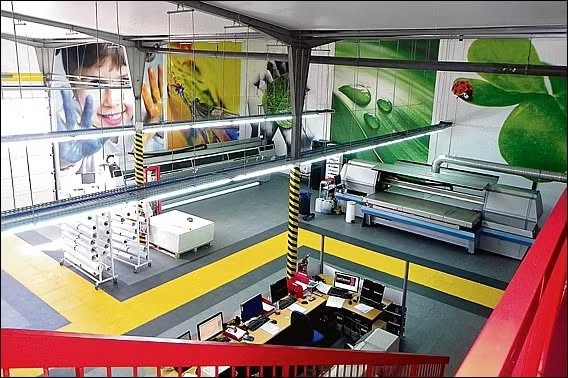
450people at the workshop
24 h/24production 7 days a week
10 000orders manufactured per month
4printing technologies
Your prints are produced in a workshop located in the European Union, specialising in large format. More than 450 people work there, and production runs 24 hours a day, 7 days a week. More than 10 000 custom orders leave it every month.
Everything is done under one roof: roll-to-roll and flatbed panel printing, cutting, stitching and welding of finishes, hardware assembly, packaging. A banner, a Dibond panel, a roll-up banner, and a complete exhibition stand can be shipped in the same order, without dealing with four different manufacturers.
It is this capacity that allows us to take on a single item as well as an entire campaign, and to meet deadlines when an event is approaching. Digital printing requires neither plates nor make-ready: the first piece costs the same as the hundredth, and each copy can display a different visual.
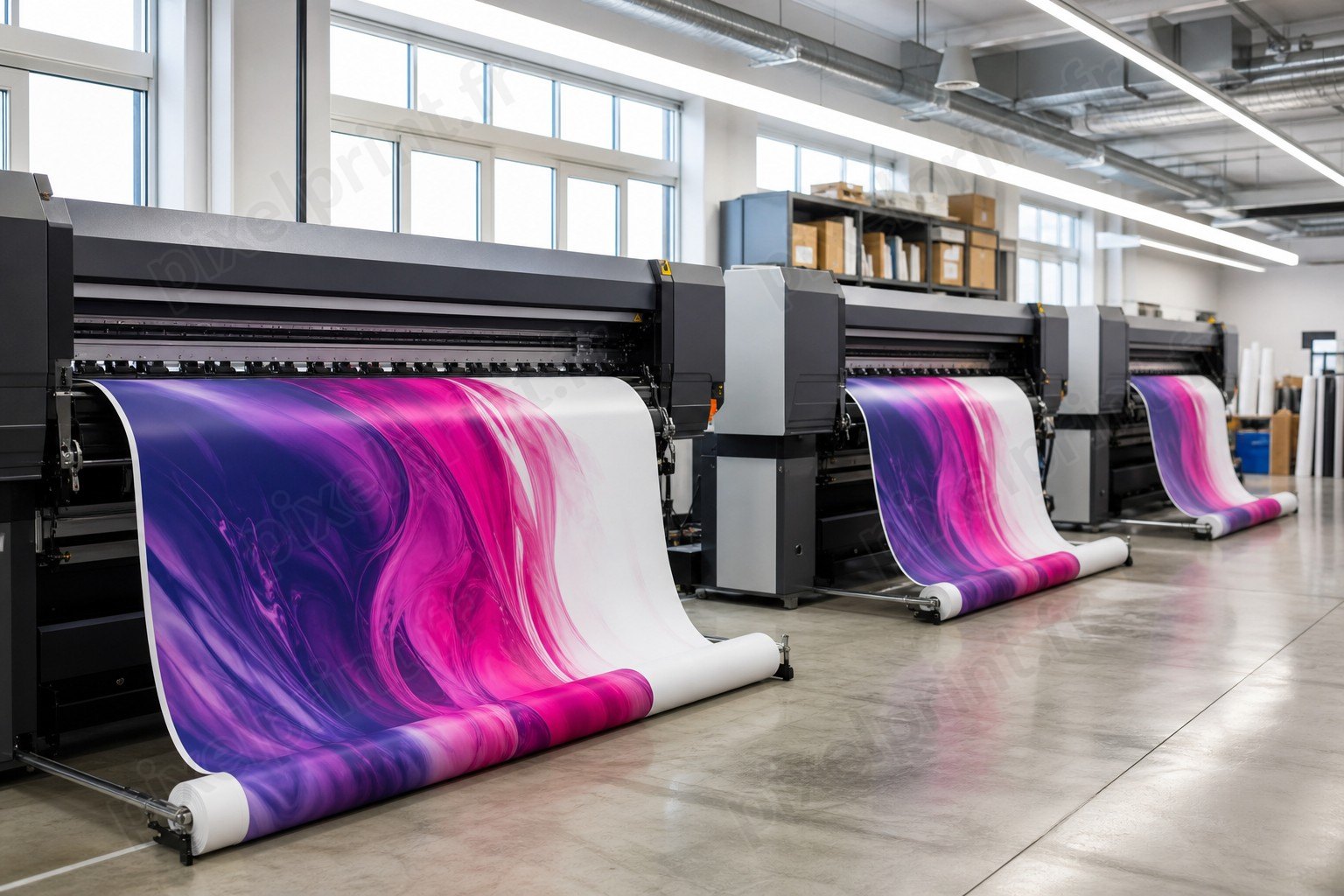
A building banner, an exhibition stand fabric, and an acrylic sheet are not printed in the same way. The workshop has four processes available. The choice depends on the material, the installation location, and the display duration: you do not have to make this choice, it is determined by the ordered product.
UV ink does not dry, it cures: ultraviolet lamps set it the moment it touches the substrate. It therefore does not require an absorbent material. This is the direct printing process on rigid panels, without applying self-adhesive vinyl: Foam PVC, Dibond, acrylic, fluted polypropylene. It also enables white printing, a white underprint underneath colours or textured layers.
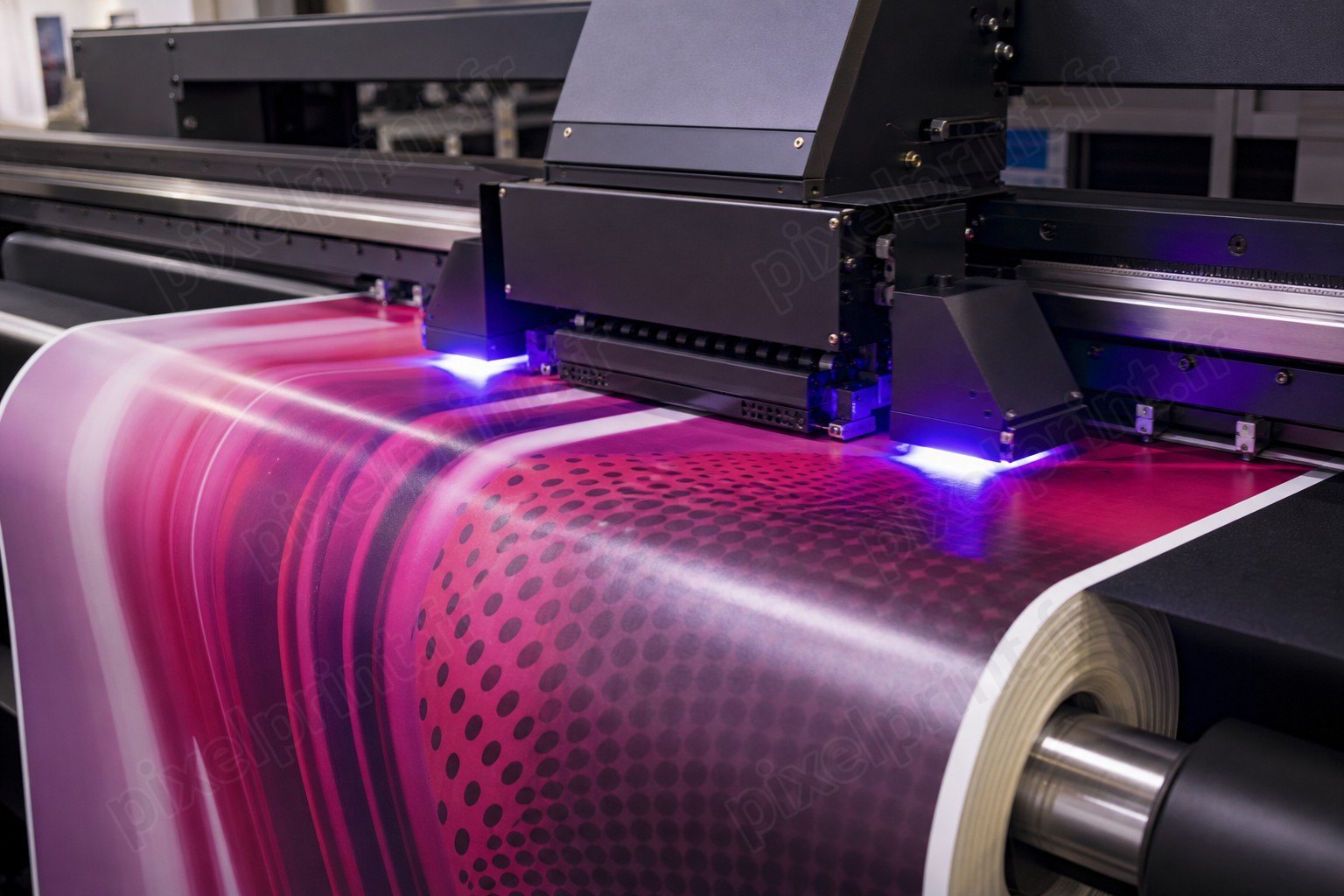
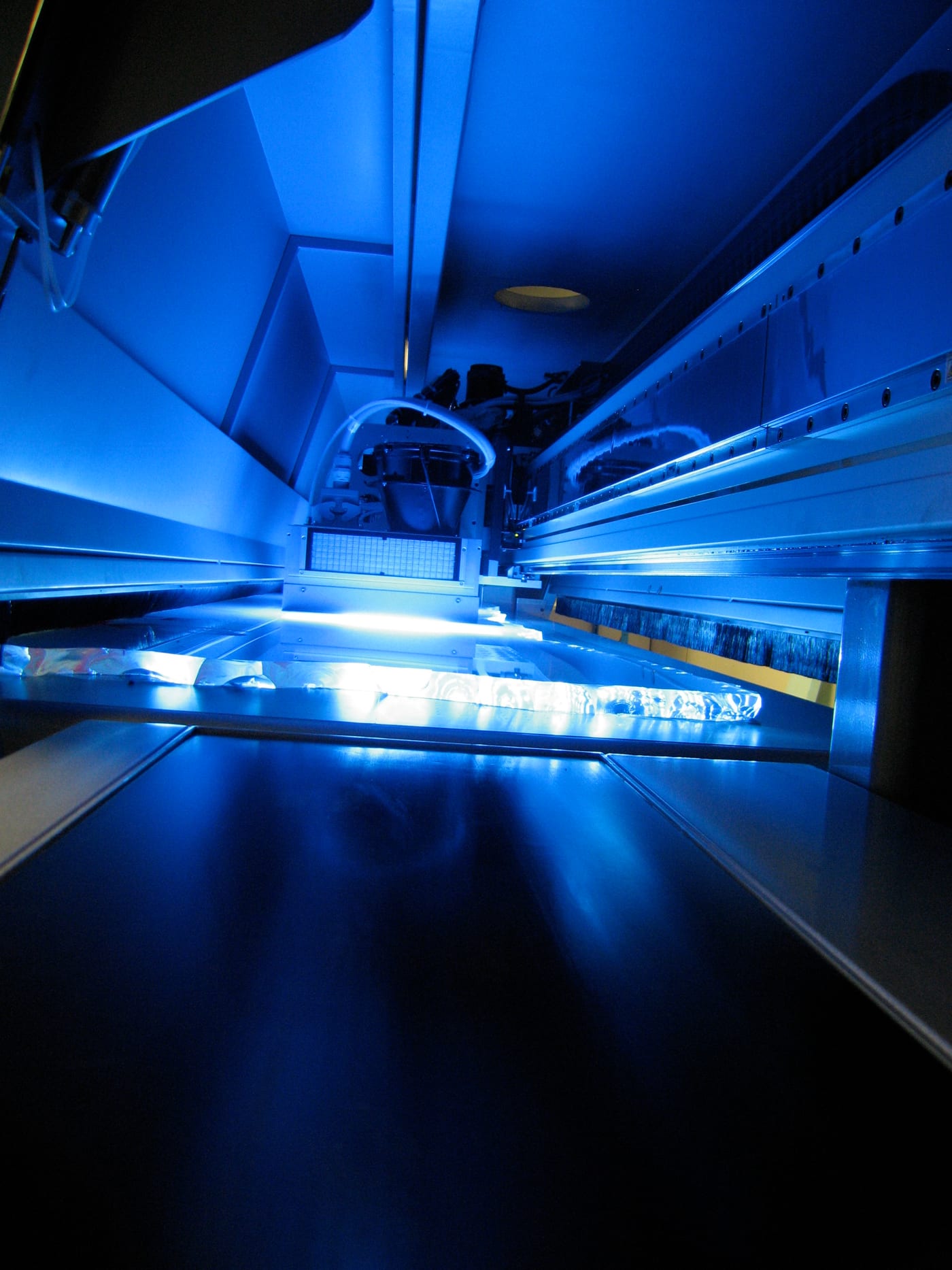
To find out more: what is direct UV printing.
The pigment is carried by a solvent that slightly etches the surface of the material, then evaporates. The ink bonds with the substrate: this is what gives banners and to self-adhesive vinyl their outdoor durability, in sun and rain. Eco-solvent inks, with fewer volatile compounds, have replaced the older formulas.
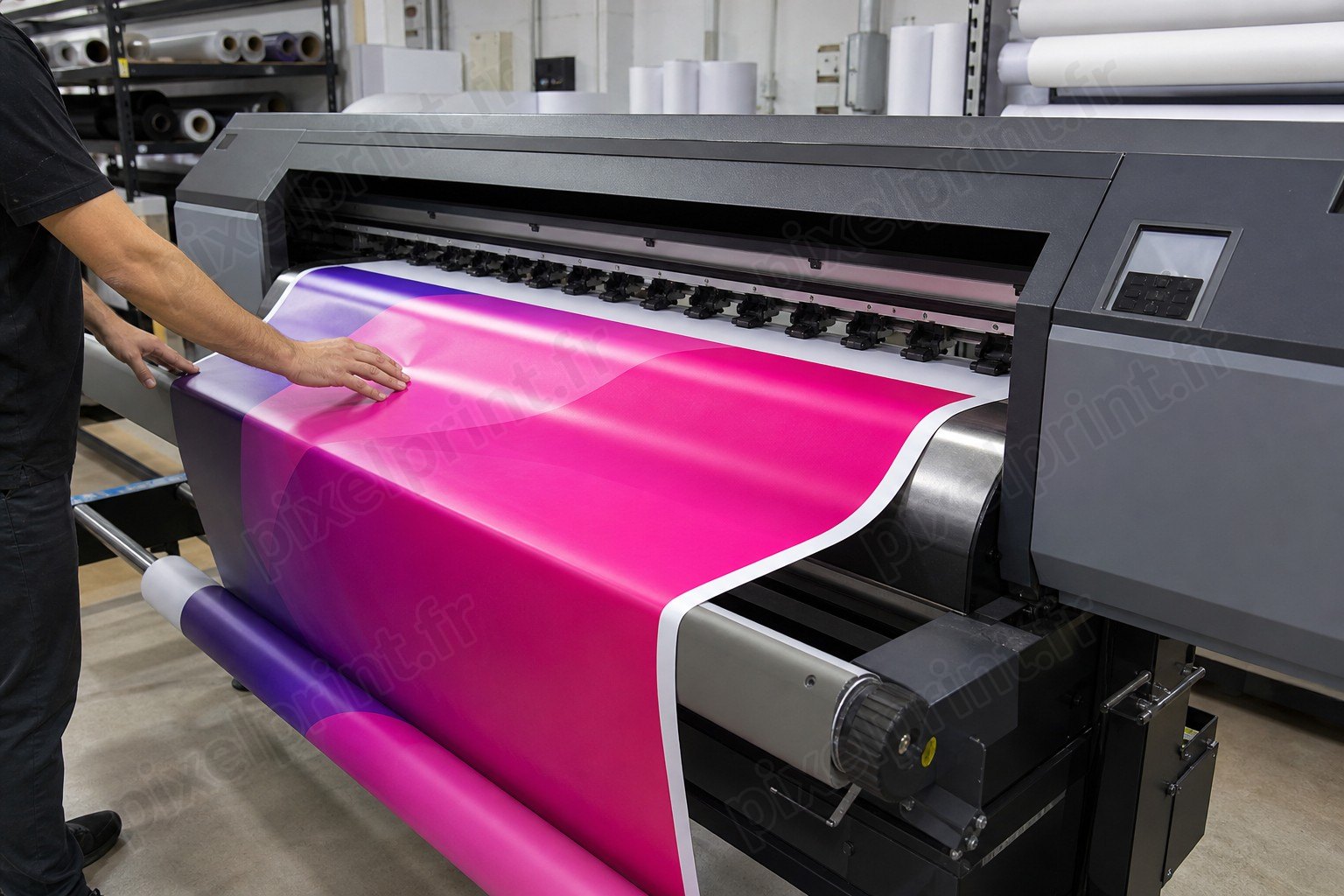
Pigments suspended in water, heat-cured with a polymer film. Odourless, latex printing is suitable for indoors: shops, offices, schools, healthcare facilities. It comes out dry from the machine, ready to be cut or installed.
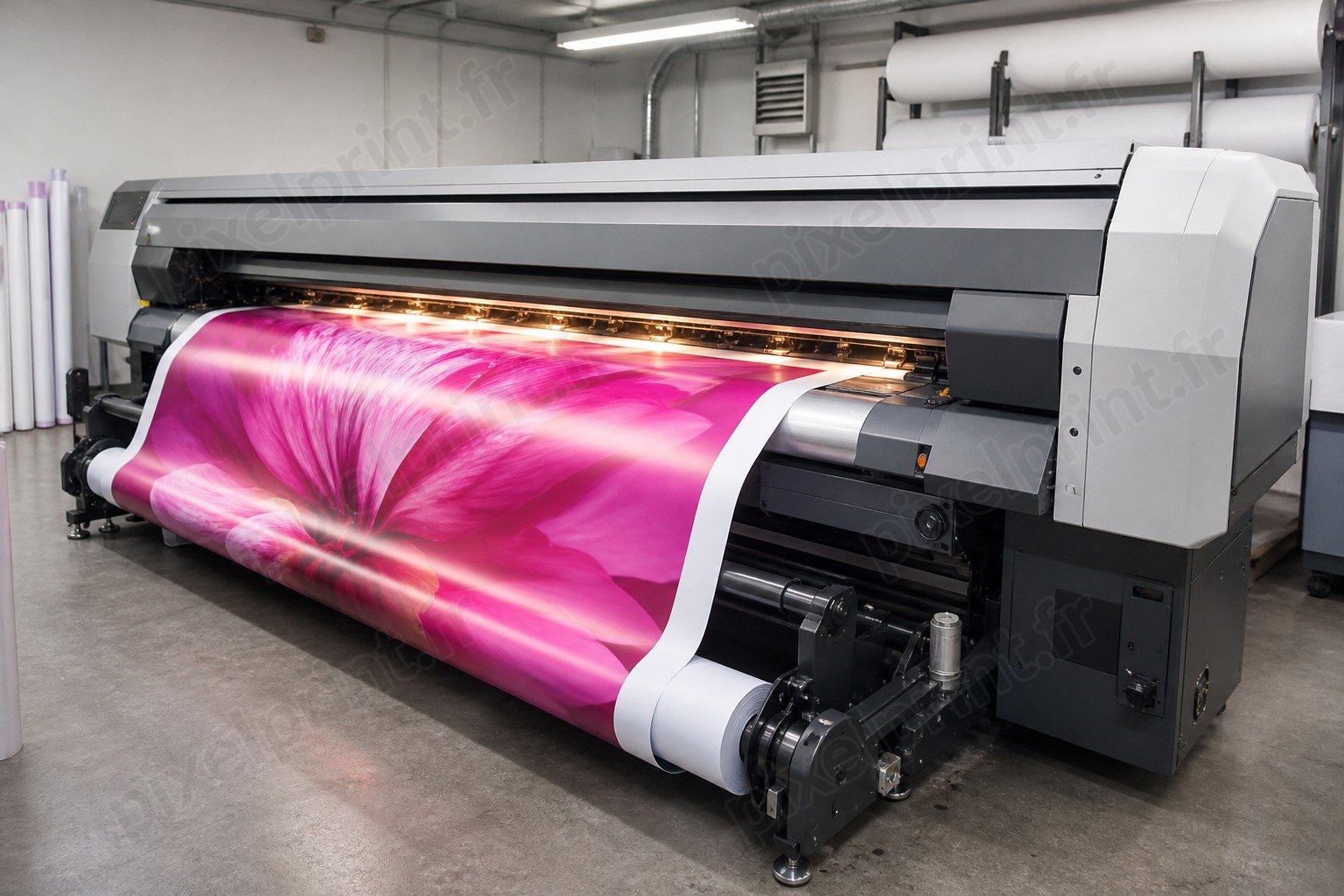
For fabrics, the ink is heat-transferred into the polyester fibre: it does not sit on the surface, it dyes the yarn. The graphic does not crack or peel, and the fabric remains flexible. This is the process used for flags, beach flags, exhibition stand fabrics, textile frames, and tablecloths.
The article solvent, UV, latex inks: what are the differences compares these processes in detail.
Flexible materials arrive in rolls: banner, self-adhesive vinyl, paper, fabric. They pass under the print heads and come out rolled up, making it possible to print very long single pieces. Rigid panels, on the other hand, are placed on a bed: the head moves above the board. The workshop is equipped for both, with the accompanying finishing stations.
Cutting is computer-controlled. The workshop works notably with Zünd cutting tables, including a G3 3XL-3200: its large bed is divided into two working zones, allowing one board to be loaded while the other is being cut, and a camera detects the graphics to follow a contour as closely as possible.
This is what makes possible the cut to shape of a panel, a letter, or a life-size cutout, with its assembly slots. An automated Zünd BHS150 cutting line handles production runs: boards are loaded and offloaded without manual handling.
A print is not a finished product. In the workshop, banners receive their hems, their eyelets and their pole pockets. Fabrics are sewn, fitted with their keder or their velcro. Self-adhesive vinyls are laminated when they need to withstand abrasion. Roll-up banners and exhibition stands are assembled and inspected before being packed into their carry bag.
All these finishes can be selected on the product page, along with their pricing: the glossary explains each of them.
The workshop is ISO 9001:2015 certified. This standard does not apply to a product, but to the organisation: each order follows a defined process, from file checking to packaging, and any deviation is recorded and addressed. For you, this means a product consistent with what was ordered, and a repeatable result from one order to the next: the same colour, the same cut, the same finishing.
pixelprint is a brand of SAS ATON, a French company based in Nice. This is where we prevent unpleasant surprises:
Lead times and shipping methods are detailed on the delivery.
Nothing is printed in advance: each item is made to order, in the quantity requested. There is no unsold stock and no minimum quantity required. Many of our substrates are also reusable: for a roll-up banner, a textile frame, or an exhibition stand, you keep the hardware and only replace the graphic for the next campaign.
Over 400 orders delivered, 70 trade clients. The reviews published on the website are from clients who have actually placed an order. You can leave your own after an order: it helps future customers make their choice.
In a large-format production workshop located in the European Union. Advice, file checking and order tracking are handled from Nice.
Yes. Digital printing requires no costly set-up at the start: a single piece is produced just like a run.
Yes, every file is checked, then a proof is submitted to you. Production only begins after your approval.
Whichever suits the material: UV for rigid panels, solvent or latex for banners and self-adhesive vinyls, dye-sublimation for textiles.
Yes, it is ISO 9001:2015 certified, the international quality management standard.